EchoPentest Toolkit

Three surfaces. One security operating model.

Most breaches succeed through the same three paths: humans, networks, and infrastructure. The EchoPentest Toolkit is engineered to close those paths with consistent evidence capture, clear prioritisation, and practical remediation—without enterprise bloat.

Mapping human risk…
Evidence-first reporting
Designed for SMB + regulated teams
Deployable as a service or project
Works with real-world constraints
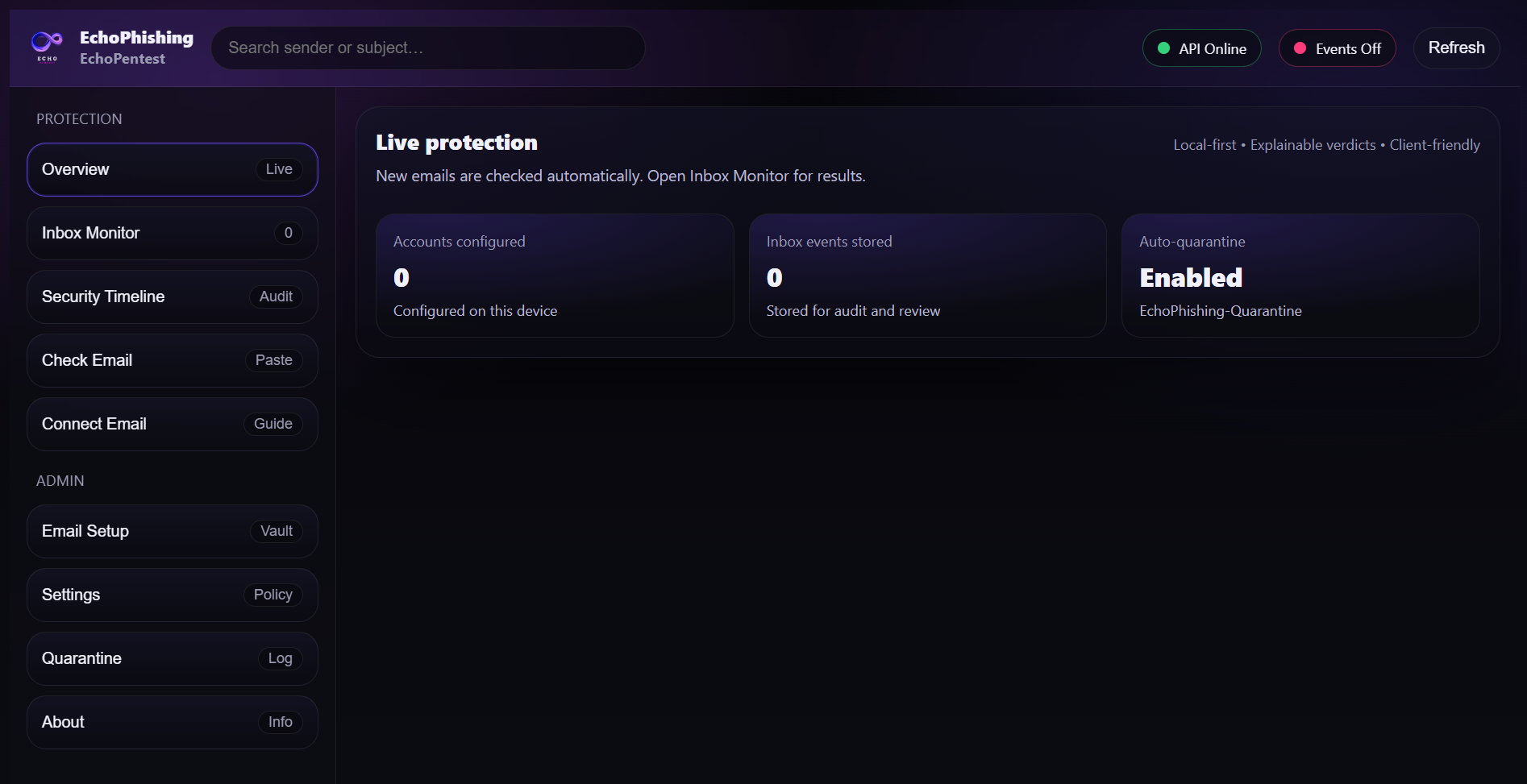
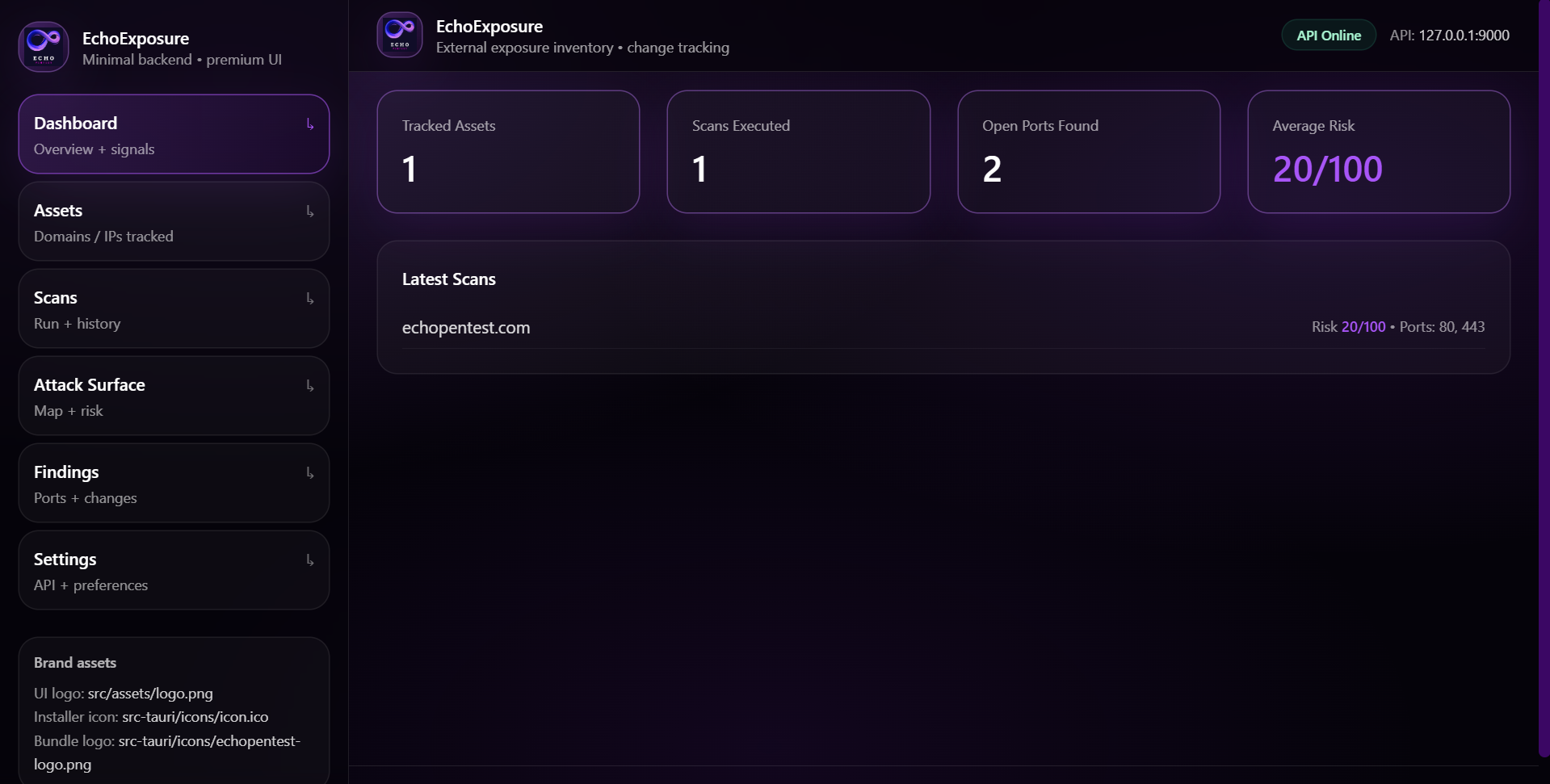
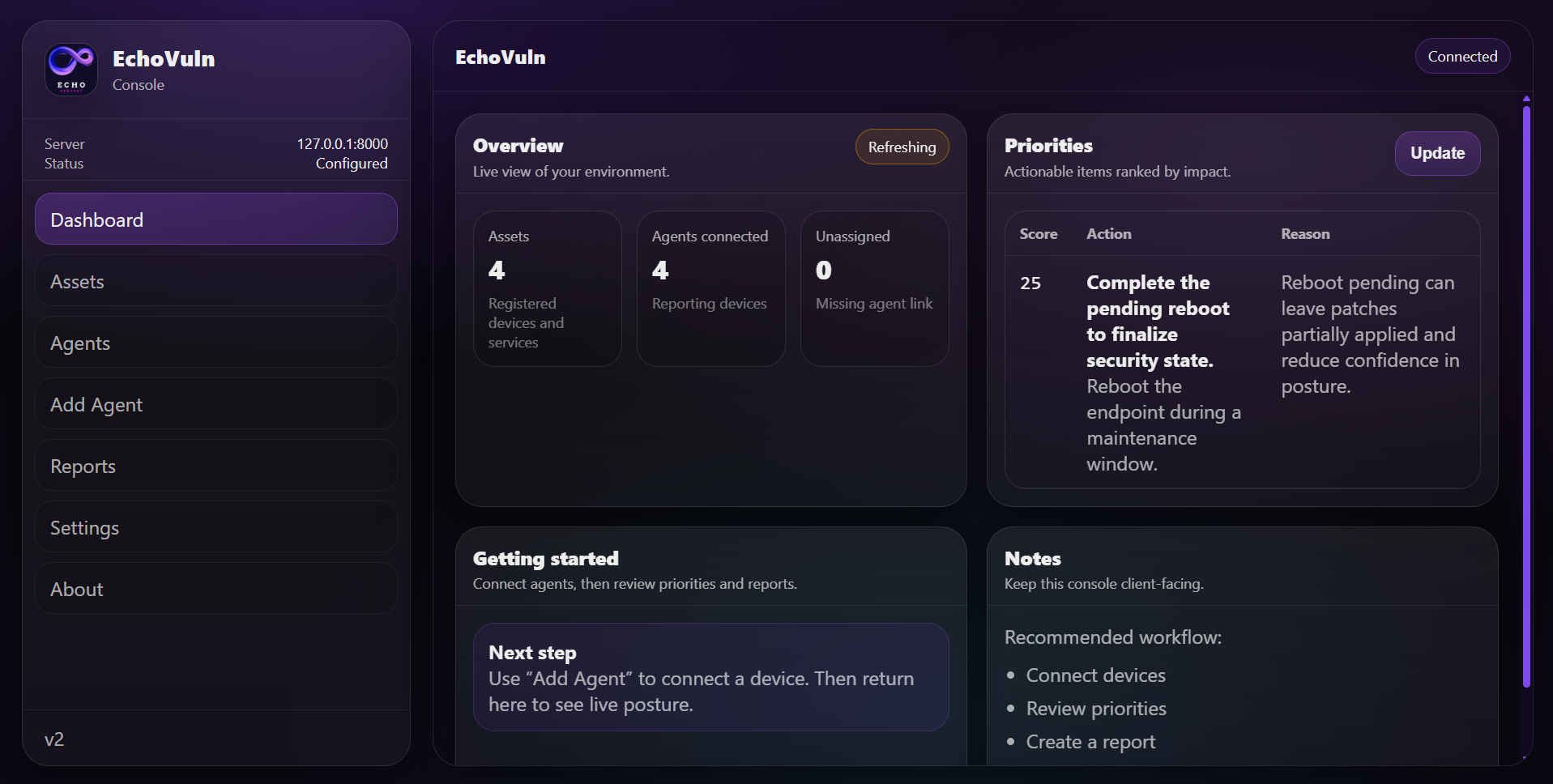
EchoPhishing screenshot EchoExposure screenshot EchoVuln screenshot
EchoPhishing EchoExposure EchoVuln

What you get

Coverage of the three most exploited failure domains, delivered as a coherent toolkit:

  • • Human-layer phishing defence with continuous monitoring options
  • • Network exposure visibility across assets, ports, services and certificates
  • • Endpoint + infrastructure vulnerability posture with prioritised fixes
  • • Executive-ready outputs and engineer-grade evidence

How it’s different

Not “just tools.” Not “just a pentest.” A repeatable protection loop:

  • • Baseline → detect drift → prioritise → remediate → verify
  • • Findings written as actions, not raw scanner noise
  • • Consistent scoring and remediation guidance across products
  • • Built for owners and small teams, not only SOCs

Toolkit overview

Each product solves a different part of the attacker workflow. Together, they reduce initial access, limit discovery and expansion, and remove the privilege paths attackers depend on.
EchoPhishing Human layer

Phishing succeeds when a message feels normal. EchoPhishing looks at the signals humans miss: authentication, sender patterns, language cues, links, attachments, and behavioural anomalies.

  • • Inbox monitoring via IMAP with event timeline
  • • Header and authentication checks (SPF/DKIM/DMARC indicators)
  • • Link + attachment risk cues (safe metadata inspection)
  • • Explainable scoring (why the email is risky)
  • • Analyst mode: paste raw email text for rapid triage
Designed for: account-takeover prevention, invoice fraud, CEO fraud, credential phishing
Outputs: risk score, reasons, evidence, recommended action
Cadence: continuous monitoring or periodic mailbox reviews
EchoExposure Network layer

Attackers win by finding what you forgot was exposed. EchoExposure builds an accurate map of reachable assets and services, then highlights the small set that creates real risk.

  • • Asset discovery (IP ranges, hosts, services)
  • • Port/service enumeration with evidence capture
  • • TLS certificate intelligence (expiry, weak posture signals)
  • • Exposure classification: internet-facing vs internal
  • • Change tracking: what appeared, disappeared, or drifted
Designed for: shadow IT, misconfigured firewalls, legacy services, remote access risk
Outputs: asset inventory, exposure list, top risks, remediation steps
Cadence: monthly external checks + internal scans per change window
EchoVuln Infrastructure layer

Most organisations don’t fail because they lack a scanner. They fail because they can’t prioritise, validate fixes, or keep posture stable. EchoVuln focuses on decision-grade vulnerability management.

  • • Endpoint posture snapshots (versions, configs, indicators)
  • • Vulnerability detection + severity/risk prioritisation
  • • “Top fixes” engine: the smallest set of changes that removes the most risk
  • • Verification loop: retest to confirm fixes actually closed the gap
  • • Report-ready evidence for audits and leadership
Designed for: patching prioritisation, hardening, reducing lateral movement paths
Outputs: prioritised remediation backlog, proof of fix, drift alerts
Cadence: continuous posture or quarterly hardening cycles

How the toolkit works together

Attacks are a chain. Breaking any link helps, but breaking the chain systematically is what prevents repeat incidents.

Attacker workflow coverage

  • • Initial access: phishing and account takeover signals (EchoPhishing)
  • • Discovery and expansion: exposed services + reachable assets (EchoExposure)
  • • Privilege and persistence: patch gaps + weak configs (EchoVuln)
  • • Verification: re-test after changes so security doesn’t regress

What clients actually see

  • • A clear “Top 10 actions” list that removes the most risk first
  • • Evidence screenshots/logs for every finding (no trust required)
  • • Plain-English explanations for owners + technical notes for engineers
  • • A repeatable cadence: monthly/quarterly checks and change validation

Enterprise-grade delivery principles

The toolkit is built to behave like a professional security service: scoped, measurable, auditable, and privacy-aware.

Evidence, not noise

Outputs are structured around actions and verification. Every high-severity item includes: proof, impact, likelihood, and the fastest credible fix. No “1,000 findings” reports.

  • • Consistent scoring logic across products
  • • Fix-first reporting with a re-test requirement
  • • Drift detection to catch regressions early

Operational fit

Most teams don’t have a SOC. This toolkit fits real environments: one IT admin, a vendor, or a small engineering team. It is designed to be used repeatedly, not once.

  • • Lightweight onboarding and clear scopes
  • • Minimal friction for IT and leadership
  • • Roadmap planning: 30/60/90 day hardening plan

Deploy once. Improve continuously.

A single assessment is useful. A repeatable security loop is what stops repeat incidents. The EchoPentest Toolkit can be delivered as a one-time engagement, or as an ongoing protection program with scheduled checks, reporting and re-testing.

  • • Baseline the business: humans, network, infrastructure
  • • Prioritise actions that reduce risk fastest
  • • Verify fixes and track drift over time
  • • Keep documentation audit-ready
Clear scope. Clear deliverables. Clear actions. No theatre.
  • Human layer: reduce compromise through inbox risk visibility
  • Network layer: remove exposed services and unknown assets
  • Infrastructure layer: prioritise patches and hardening that matters
  • Verification: confirm fixes and prevent regression